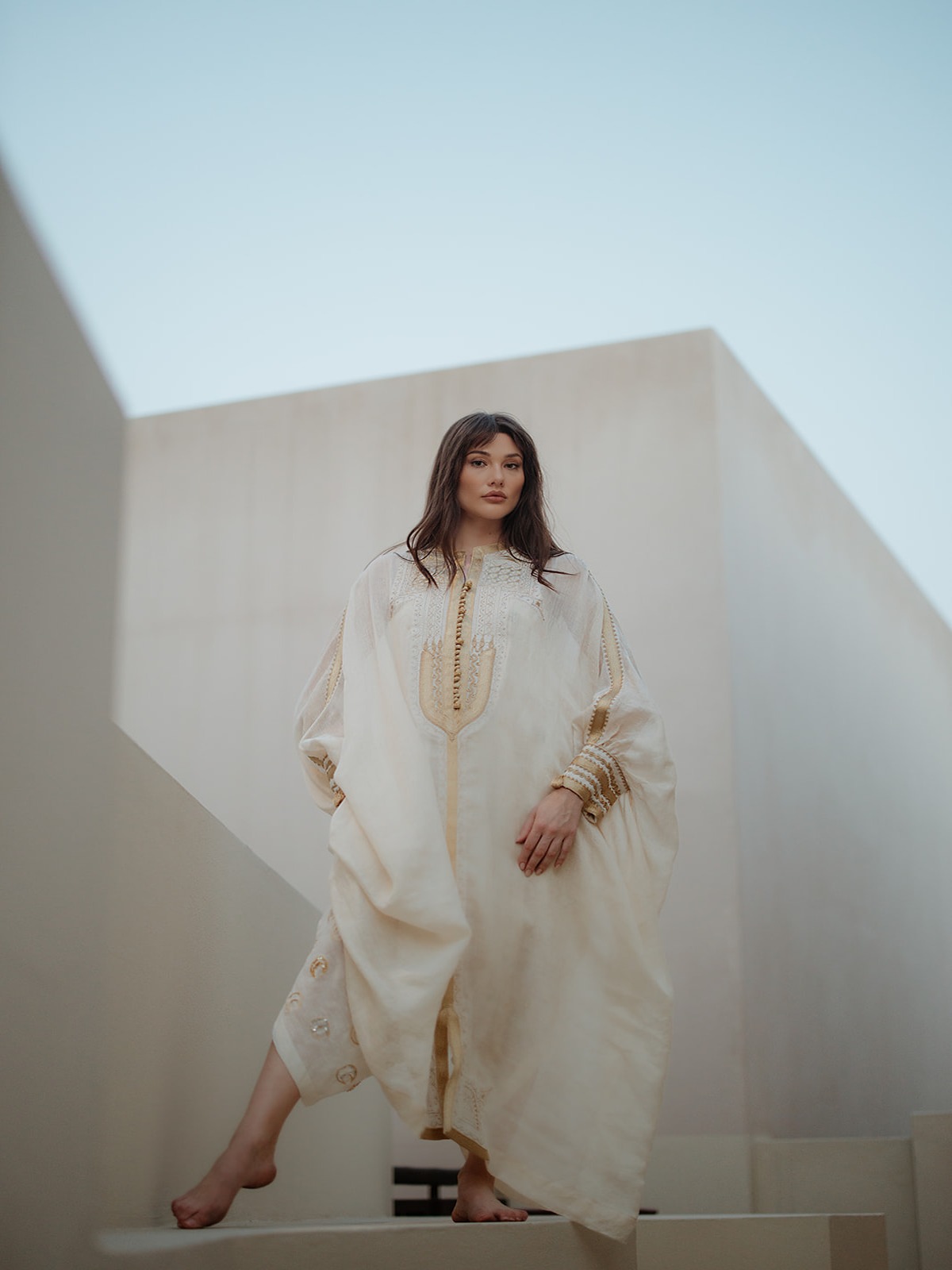
Choose abaya designs by customer and occasion first. Then test each one against fabric behaviour, construction effort and sampling risk. A coherent range gives every piece a clear job and links the pieces through fabric, proportion or one signature detail.
The seven approaches below are not seven separate garment categories. Abaya silhouettes, front construction, embellishment and occasion overlap, so one piece can fit several. Use them to shape a development brief for your modestwear collection, not as a menu to launch in full.
Abaya Designs Compared at a Glance
| Approach | Customer and occasion | Fabric behaviour | Relative complexity |
| Minimal closed-front | Daily and work | Fluid, opaque, stable | Lower: few seams, exposed finishing |
| Open-front layering | Daily, travel, layered looks | Medium drape, stable edges | Lower to moderate: edges and balance |
| Butterfly | Gatherings, festive days | Light, fluid, opaque in motion | Moderate: sleeve volume |
| Tailored | Work, formal daytime | Structured, crease-resistant | Higher: shaping, lining, collars |
| A-line or panelled | Daily to occasion | Medium body, holds shape | Moderate: panel matching |
| Embroidery placement | Elevated daily, occasion | Stable enough to carry stitching | Moderate to higher: alignment |
| Controlled statement | Weddings, evenings | Depends on detail and layers | Higher: several components |
Complexity is relative to the other approaches. It is not a cost or timeline.
Fabric Names Are Not Specifications
Nida, crepe and satin describe a look and handfeel, not a guaranteed fibre or performance. Retailers describe nida in different ways, and an Oman Observer article calls it a polyester fabric. Fabric drape depends on stiffness, weight and thickness, and also varies with fibre, yarn, structure and finish. Ask for composition, weight and swatches. Judge drape and opacity on a sample.
Seven Abaya Designs to Consider
1. Minimal Closed-Front Abaya
A closed-front abaya is worn as a complete outfit, unlike an open style worn over another. It suits customers who want quick, polished dressing for work or daily use. In a premium range, it is the quiet core. With no decoration to hide behind, fit and finishing carry the price position. Choose a fluid, fully opaque fabric that hangs cleanly. Construction is simple, but neckline and closure faults show immediately.
Sampling check: sit, walk and raise your arms, then check the closure for pulling and the fabric for show-through.
Trade-off: it is easy to produce and easy to imitate, so quality must do the work.
2. Open-Front Abaya for Layering
An open-front abaya hangs open or fastens at one point. It suits customers who change what they wear underneath, from workwear to dresses. In a range, it adds flexibility. Use a medium-drape fabric with stable edges, so fronts do not curl or stretch. The main challenge is front-edge finishing and hanging weight, because there is no closure to hold the shape.
Sampling check: wear it open, belted and half-fastened, watching the front edges.
Trade-off: it depends on what sits beneath it, so decide whether you will also sell inner dresses.
3. Butterfly Abaya
A butterfly abaya, also called batwing, has a wide cut running from shoulder into sleeve, so raised arms create a wing-like shape. Treat the two names as one silhouette. It suits gatherings and festive days where movement is the point. In a range, it is the expressive counterpart to a clean closed style. The fabric must be light and fluid, yet opaque enough that lifted sleeves do not reveal the arm. Sleeve volume and underarm shaping are the challenges.
Sampling check: raise both arms, then photograph from front and side and check cuff comfort.
Trade-off: the width adds drama but affects fabric use, so confirm with a marker before committing.
4. Tailored Abaya
A tailored abaya borrows from coats: defined shoulders, structured collars, lined bodies and controlled sleeves. It suits professional customers and formal daytime settings. In a premium range, it signals technical skill, with the price position justified by fit rather than decoration. Choose structured, crease-resistant fabric that holds edges. This is the most demanding approach, with interlining, collars, lining and sleeve setting all needing control.
Sampling check: reach forward while seated and check shoulder and armhole movement.
Trade-off: structure reduces flow, so it may feel less fluid than other pieces in your range.
5. A-Line or Panelled Abaya
An A-line abaya widens gently from shoulder or waist to hem. Panelled versions add vertical or flared sections. It suits customers who want shape without a fitted cut. In a range, it bridges daily and occasion wear, because panels add interest without surface decoration. The fabric drape needs enough body to hold the shape but enough movement to hang well. Matching panel seams and grain direction is the main challenge.
Sampling check: view the hem from every angle and confirm panel seams hang straight.
Trade-off: more panels mean more seams, and more chances of inconsistency between sizes.
6. Abaya with Considered Embroidery Placement
Here, embroidery is a placement decision rather than a category. It can sit on a closed, open or tailored base, typically at cuffs, hems, fronts or back panels. It suits customers seeking elevated daily or occasion pieces, and it can become a signature. The base fabric must carry stitching. Dense embroidery on lightweight fabric can pucker, so stabilising and testing matter. Aligning motifs across seams and sizes is the other challenge.
Sampling check: press or steam the sample, then compare how embroidered and plain areas hang.
Trade-off: richer detail adds stiffness and work to every piece.
7. Occasion Abaya with a Controlled Statement Detail
This design uses one deliberate focal feature, such as a sheer overlay, pleated sleeve or beaded cuff, rather than decoration everywhere. It suits weddings and evening events. In a range, it is the showpiece, while core pieces carry volume. The detail and base fabric must behave together, and sheer layers need lining or an opaque base. The challenge is combining overlay, trim and lining without bulk.
Sampling check: test care, shrinkage and colourfastness on every component together, since mismatched layers can distort.
Trade-off: one strong detail looks refined, but it concentrates risk in a single feature.
How to Build a Coherent Modestwear Collection
Start with three decisions: your customer, the occasion she dresses for, and your retail price position. Write one sentence for each. For a first launch, three to five cohesive abayas is a sensible range, rather than mixing distant ideas.
Then give each design a job. Use a closed or open-front abaya as the core, an A-line or butterfly abaya for shape, embroidery placement as a signature, and a statement piece as the showpiece. Connect them through colour, fabric family, sleeve proportion or a repeated detail. Keep two or three everyday designs for every demanding one, and limit base fabrics, colours and sizes at first. Each extra variable multiplies sampling. Our guide to a cohesive fashion collection covers this thinking more broadly.
Illustrative example, not client work or a proven sales formula: a founder serving working professionals selects five pieces. They are a closed-front core, an open-front layer in the same fabric, an A-line piece in a second colour, a tailored abaya, and one occasion piece with a beaded cuff. The first three share fabric and proportion. The tailored and occasion pieces carry the technical risk, so they are limited.
For abaya sampling, make each design in its intended fabric, not a substitute, and record decisions in a tech pack. Request swatches and sample yardage through fabric sourcing. When you are ready to turn abaya designs into samples and a production-ready range, our Fashion Production & Low MOQ service covers prototype and sample development, and tech pack creation.
Conclusion
The best abaya designs for a premium collection are not the most decorated. They are the ones with a clear customer, suitable fabric, controlled construction and abaya sampling that proves the design. Choose a few, give each a role, and let finishing carry the quality. If you want to talk through your direction, discuss your collection brief with The Fashion Coterie.
FAQs
How do I choose abaya designs for a first premium collection?
Start with one customer and occasion, then choose three to five designs that serve distinct roles. Prioritise fit, finishing and fabric suitability over variety. Sample the core pieces first, then add a signature or statement piece.
Which fabrics should I sample for a Dubai abaya collection?
Sample fabrics matched to each design’s job: fluid options for closed and butterfly styles, structured ones for tailored pieces. Compare at least two candidates per design for drape, opacity, creasing and care, using specifications rather than names.
What should I check when sampling a butterfly abaya?
Raise both arms and check opacity, underarm comfort and how the sleeve falls. Photograph the sample from front and side. Also confirm that the cuff and seams withstand repeated lifting without pulling.
How does embroidery placement affect development and production?
Placement affects fabric stability, drape and alignment. Embroidery near seams, hems or cuffs needs careful positioning across sizes. Test stabilising on the actual fabric, because dense stitching can pucker lighter materials.
Should every abaya design use the same base fabric?
Not necessarily. A shared base fabric improves consistency and simplifies sourcing, but tailored or butterfly designs may need different drape or structure. Aim for a small fabric family that suits each silhouette.