If you’ve started researching how to produce your first (or fifth) clothing collection, you’ve probably run into three terms that get thrown around almost interchangeably: clothing manufacturer, private label, and full-package production. They are not the same thing, and mixing them up is one of the most common – and most expensive – mistakes new fashion brands make.
Pick the wrong model, and you’ll either overpay for services you don’t need or underpay a partner who can’t deliver what your brand requires. This guide breaks down what each term really means, how they differ in practice, and how to figure out which one is right for where your brand is right now.
What Is a Clothing Manufacturer?
“Clothing manufacturer” is the broad, catch-all term – it simply means a company that physically produces garments. Within that umbrella sit several distinct working relationships, and the differences come down to one question: how much of the production process does the factory own, and how much do you have to manage yourself?
At the most basic end, a manufacturer might only offer CMT (Cut-Make-Trim) services. You supply the fabric, trims, and finished tech pack; the factory cuts, sews, and finishes the garment. That’s it. You’re still responsible for sourcing materials, quality-checking the output, and coordinating shipping. This model works well if you already have a fabric sourcing relationship and need production capacity – but it puts a lot of project management on your shoulders.
A good clothing manufacturer partner will tell you upfront which of these services they actually offer in-house versus what they outsource – a distinction that matters more than most brands realize until something goes wrong mid-production. If you want the full picture of how this works day-to-day, our guide on apparel production management breaks down each stage in detail.
What Is Private Label Manufacturing?
A private label clothing manufacturer produces garments – often from an existing base pattern or template – and then applies your brand’s labels, hangtags, and packaging before shipping. The core garment design is usually not built from scratch for you; instead, you’re customizing an existing product (fabric, color, minor design tweaks, branding) rather than starting from a blank page.
This is the fastest, lowest-cost way to get a genuinely branded product to market, which is why so many DTC and boutique brands start here. The trade-off is limited design flexibility – if you want a truly original silhouette or construction, private label typically isn’t built for that. Many founders weighing this route first read our guide on how to start a clothing brand in Dubai before deciding whether to test a category this way or commit to full custom development.
What Is Full-Package Production (FPP)?
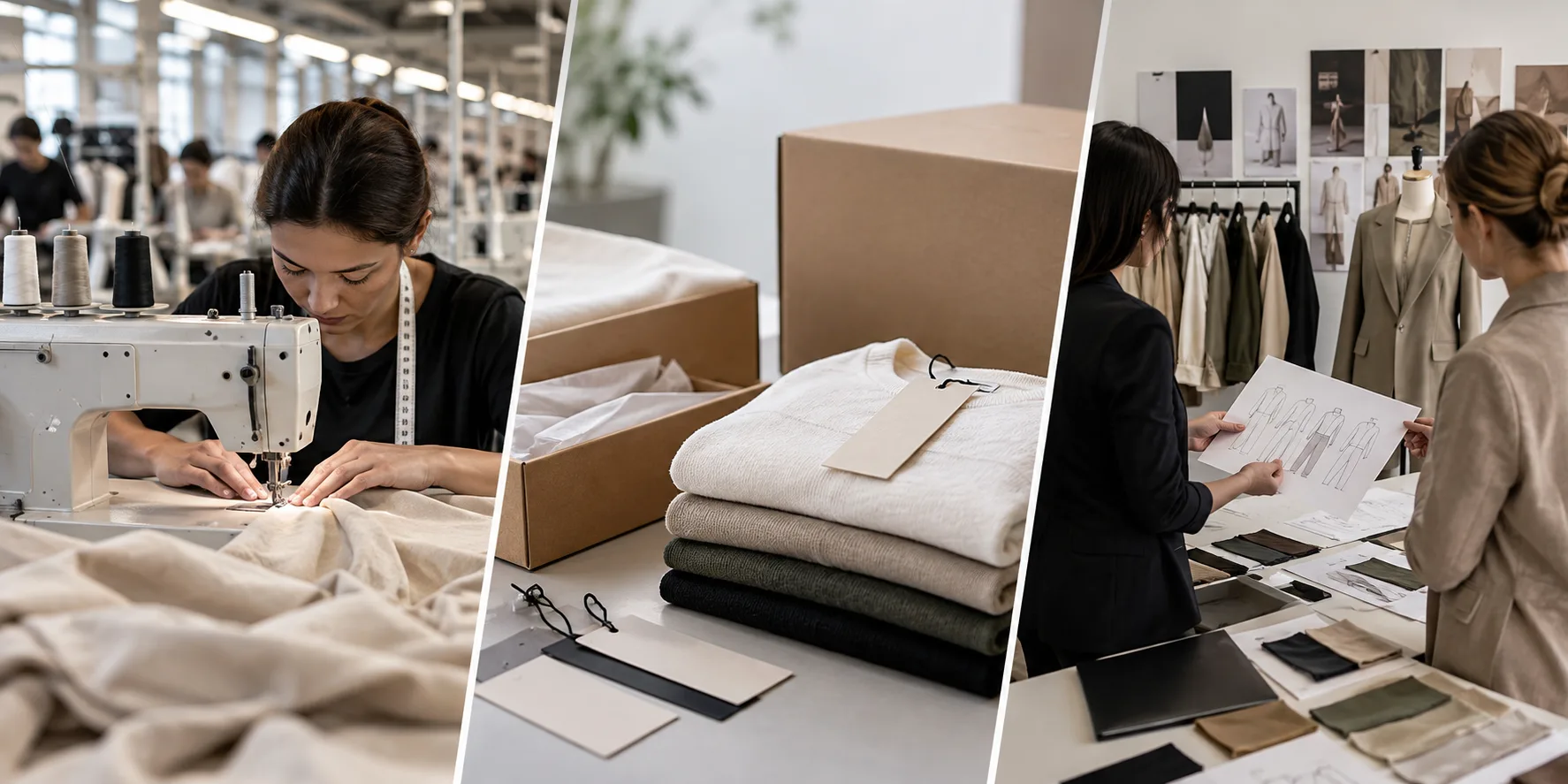
Full-package production is the most comprehensive model. A full-package factory – sometimes called a “one-stop-shop” or vertically integrated manufacturer – handles the entire lifecycle: design assistance and tech pack development, fabric and trim sourcing, sampling and fit iteration, bulk cutting and sewing, quality control, private labeling, and even packaging and logistics, all under one roof or one coordinated system.
The appeal is obvious: one point of accountability instead of five vendors to chase. The trade-off is usually a higher MOQ and a longer relationship-building period, since the factory is investing more into understanding your brand. This is the model most apparel clothing manufacturers in Dubai now offer as a package once a brand has proven demand and needs to scale reliably, because it removes the coordination overhead that kills timelines when production is split across multiple vendors. Sampling is usually the make-or-break stage here – see our notes on clothing sampling for what to check before approving a bulk run.
Clothing Manufacturer vs. Private Label vs. Full-Package: Key Differences at a Glance
- Design ownership: CMT requires you to supply a finished tech pack; private label works from an existing template with light customization; full-package develops an original design with you from scratch.
- Fabric sourcing: With CMT, you source your own fabric. Private label factories usually source it for you. Full-package factories source everything, including trims.
- Typical MOQ: CMT MOQs vary and are often lower if you already have materials ready. Private labels sit low-to-moderate. Full-package tends to run moderate-to-high since more services are bundled in.
- Speed to market: Private label is fastest since there’s no design phase. CMT can be fast if you’re fully prepared. Full-package is slower upfront but scales more reliably.
- Best fit: CMT suits brands with existing supplier relationships. Private label suits startups testing a new product line. Full-package suits brands ready to scale a distinct, original product.
- Coordination burden on you: Highest with CMT, since you’re managing fabric, QC, and logistics yourself. Low-to-medium with private label. Lowest with full-package, since one factory owns the whole process.
- Branding control: All three give you full branding control – the difference is how much of the product itself you’re also controlling.
Which Model Is Right for Your Brand?
- Choose CMT if you already have reliable fabric sourcing and simply need sewing capacity – typically established brands with in-house production knowledge.
- Choose a private label if you’re validating a new product category quickly and don’t need a fully original design yet – typically early-stage founders and boutiques.
- Choose full-package production if you have a distinct design vision, expect to scale, and want a single accountable partner managing the entire process – typically brands past the validation stage.
Common Mistakes to Avoid
- Assuming “manufacturer” means the same service everywhere. Always ask exactly which stages a factory handles in-house versus outsources.
- Choosing a private label when you need a truly original product. You’ll hit a design ceiling fast.
- Underestimating MOQ and lead-time differences between models – this is where budgets and launch dates most often break.
- Skipping due diligence on quality control processes. Ask specifically how and when QC checks happen, not just whether they exist – our checklist on questions to ask a fashion manufacturer before you sign anything covers exactly what to confirm upfront.
- Not clarifying who owns the tech pack and pattern if you switch factories later – this can lock you into a single partner unintentionally.
Future Trends in Apparel Manufacturing
Expect more factories – especially in fast-growing hubs like Dubai’s Al Quoz industrial cluster – to advertise hybrid models: lower-MOQ full-package options aimed specifically at startups, and increasing emphasis on sustainable and traceable fabric sourcing as buyers demand more transparency. Digital sampling and 3D prototyping are also reducing the time and cost of the sampling stage across all three models.
Conclusion
There’s no universally “best” model – only the model that fits where your brand is today. If you’re validating an idea, private label gets you to market fastest. If you already have supplier relationships and production know-how, CMT keeps things lean. If you’re building something original and ready to scale, full-package production gives you one accountable partner for the whole journey. Getting this decision right early saves you from costly rework – and costly partner-switching – later.
Still not sure which model fits your brand? Book a consultation, and we’ll walk through your product, timeline, and budget together.
FAQs
Q1: What’s the main difference between a clothing manufacturer and a private label manufacturer?
“Clothing manufacturer” is a broad term covering any production partner, while private label specifically means the factory applies your branding to an existing product template. A private label manufacturer is one type of clothing manufacturer, not a separate category entirely.
Q2: Is full-package production more expensive than private label?
Generally yes, because full-package includes design development, sourcing, and full-scale QC under one roof. However, it often works out cheaper overall once you factor in the time and coordination costs of managing multiple vendors yourself.
Q3: Can I switch from private label to full-package production later?
Yes, many brands start with private labels to validate demand and move to full-package once they need original designs and higher volumes. Just confirm who owns your tech packs and patterns before switching factories.
Q4: What MOQ should a startup expect from a Dubai-based clothing manufacturer?
MOQs vary widely – some Dubai manufacturers offer flexible options starting around 100 units per style, while others require several hundred. Always confirm MOQ per style, not per order, since these can differ significantly.
Q5: How do I vet a clothing manufacturer before committing?
Ask for references, request a sample before bulk production, clarify their in-house versus outsourced capabilities, and confirm quality control checkpoints in writing. A reliable partner will answer these questions specifically, not vaguely.