What is production in fashion industry?
Simply put, production in fashion industry is the process of turning a design idea into a finished garment that is ready to sell.
It covers everything – from the moment you finalise your design, all the way through to the finished product packed and ready for your customer. That includes sourcing your fabrics, building your technical documents, working with factories, checking quality, and managing your timelines.
For brands in Dubai and across the GCC, production in fashion industry also means navigating international supply chains. Most UAE-based brands work with factories and fabric suppliers in Turkey, Tunisia, Italy, and beyond – each offering different results depending on your budget, quality requirements, and order size.
Understanding this process is not optional. It is the difference between a brand that launches on time with a great product and one that burns through its budget on re-sampling and delays.
The 5 Key Stages of Fashion Production
production in fashion industry does not happen in one step. It is a pipeline – and every stage builds on the one before it.
Here is how it works:
Stage 1 – Design and Concept (2–4 weeks)
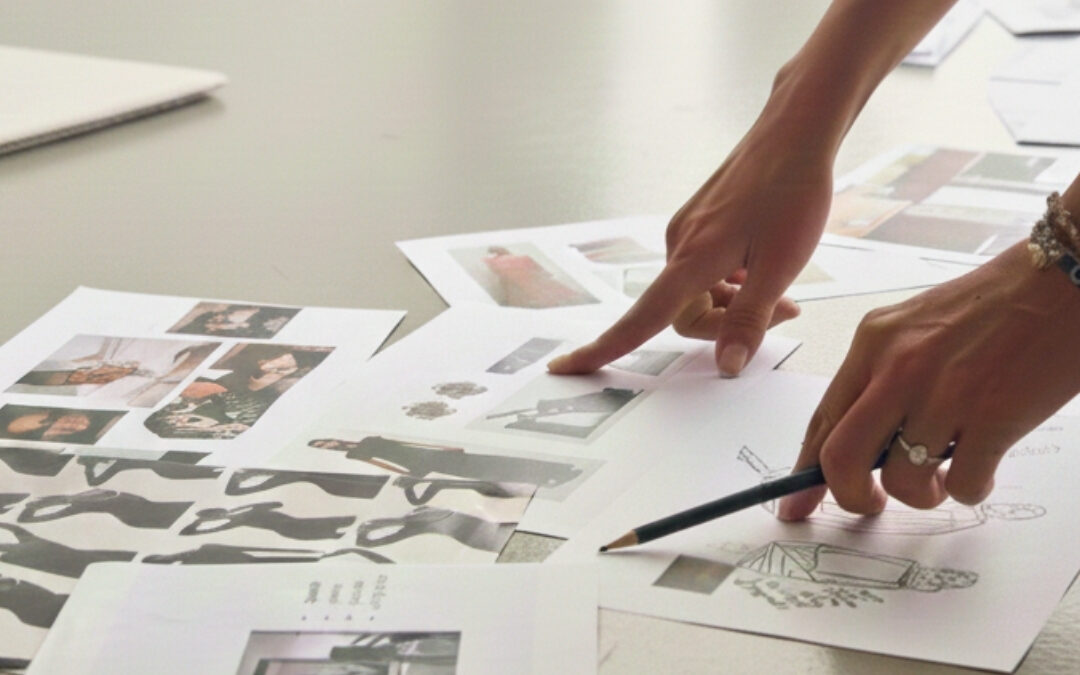
You finalise your designs, create mood boards, and plan your collection range. The output is an approved design pack ready to hand over to your technical team.
Stage 2 – Pre-Production (3–6 weeks)
This is where you create your tech pack, source your fabrics and trims, set your costs, and get patterns made. Nothing goes to a factory until this stage is complete.
Stage 3 – Sampling (2–6 weeks per round)
Your factory makes your first physical garments based on your tech pack. You review, give feedback, and repeat until the sample is approved.
Stage 4 – Bulk Production (4–10 weeks)
Once your sample is approved, the factory cuts, sews, finishes, labels, and packs your full order.
Stage 5 – Quality Control (ongoing + 1–2 weeks for final inspection)
Quality is checked throughout production and again before your shipment leaves the factory.
Miss any of these stages and you will feel it – either in your wallet, your timeline, or both.
Pre-Production: Where Every Collection Begins
If there is one stage that makes or breaks a collection, it is pre-production.
This is where most brands make their biggest mistakes – and where The Fashion Coterie focuses the most attention when working with new clients.
The Tech Pack
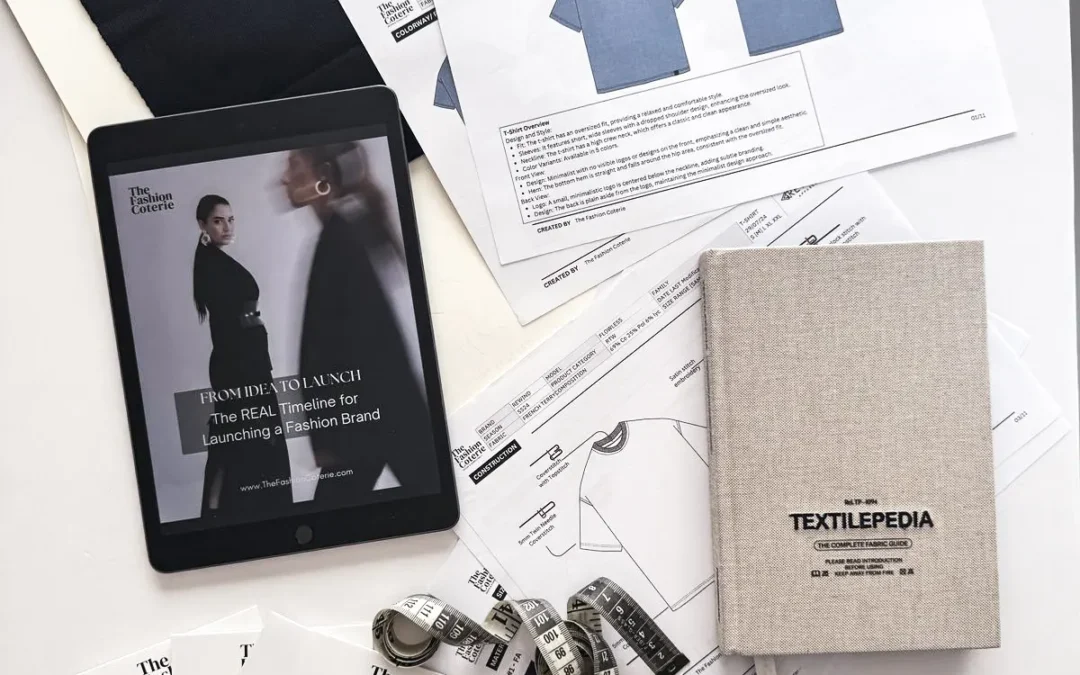
A tech pack is your garment’s instruction manual. It tells the factory everything they need to know to make your product exactly the way you designed it.
A proper tech pack includes:
- Technical flat drawings of every style
- All measurements and size tolerances
- Fabric specifications and codes
- Trim and hardware details
- Stitching and construction instructions
- Label, tag, and packaging requirements
- Colorway details
If you go to a factory without a complete tech pack, you are guessing. And guessing in fashion production is expensive.
Fabric and Trim Sourcing
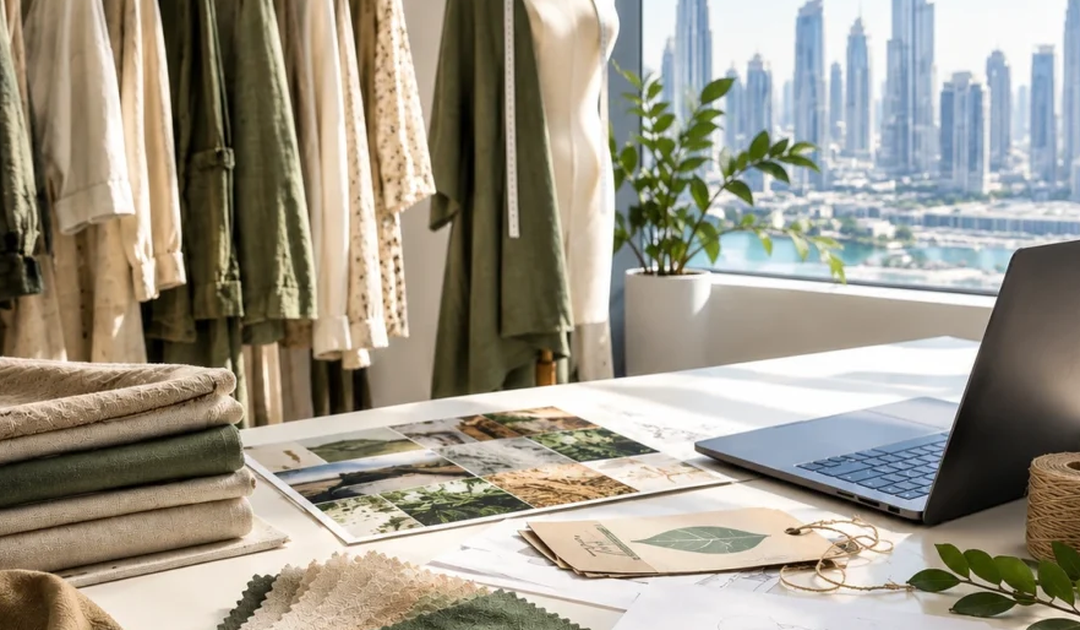
Where you source your materials has a huge impact on your final product. Here is a simple breakdown for Dubai-based brands:
- Italy – premium quality, best for luxury collections
- Turkey – great quality at competitive prices, ideal for mid-market brands
- Tunisia – cost-effective, strong for basics, denim, and activewear
At The Fashion Coterie, we source from all three regions depending on what each client needs for their specific product and price point.
Sampling: From Paper to Physical Garment
Sampling is where your tech pack becomes a real garment for the first time.
Most brands go through two to four sampling rounds before they are ready for bulk production. Here is what each round looks like:
Proto Sample – The first physical version of your design. Used to check silhouette and basic construction. Made in any available fabric.
Fit Sample – Made in your actual production fabric. This is where you check fit, proportion, and comfort across your size range.
Salesman Sample (SMS) – A retail-quality sample used for buyer meetings and product photography.
Pre-Production Sample (PPS) – The final sign-off. This confirms the factory can replicate your approved sample exactly when they go into bulk.
Each round takes 2–4 weeks. Plan for at least two rounds – brands that budget for only one almost always end up needing more, which throws off the entire production timeline.
Bulk Production: Making It at Scale
Once your pre-production sample is approved, bulk production begins.
This is the stage most people picture when they think of apparel production management – the factory floor, the cutting tables, the sewing lines. But there is a lot more to it than that.
Bulk production includes:
- Fabric inspection when it arrives at the factory
- Spreading and cutting fabric using approved patterns
- Sewing and assembling each garment
- Adding all finishes – buttons, embroidery, washing, printing
- Labelling, tagging, folding, and packing
- Building and labelling cartons for shipment
One of the biggest pain points for fashion startups is MOQ – Minimum Order Quantity. Many factories will not produce fewer than 300–500 units per style. That can be a real barrier when you are just starting out.
Working with a fashion production agency like The Fashion Coterie gives you access to factory partners who are willing to work with lower minimums – without cutting corners on quality.
Typical bulk production timelines run from 45 to 90 days from the point your fabric is approved.
Quality Control: Protecting Everything You Built
Quality control is not a single step at the end of production. It is an ongoing process that runs throughout the entire manufacturing cycle.
Professional fashion production uses a standard called AQL – Acceptable Quality Level – to determine how many garments to inspect and what defect rates are acceptable.
The three key inspection points are:
In-Line QC – Checking garments while they are still being made. This catches problems early before they multiply across your entire order.
Final Random Inspection (FRI) – A statistically valid inspection of finished garments using AQL sampling tables. This tells you whether your full order meets your quality standard.
Pre-Shipment Inspection – The last check before your goods leave the factory and payment is released.
Skipping quality control – especially when producing overseas – is one of the most expensive decisions a brand can make. Receiving a full order of defective garments is not just a financial loss. It can destroy your launch entirely.
Why Fashion Production Management Changes Everything
Here is the truth about fashion brand management in the context of production: coordinating a factory, a fabric supplier, a trim supplier, a QC inspector, and a freight forwarder – all at the same time, across multiple countries – is a full-time job on its own.
Most brand founders are also designing, marketing, selling, and running a business at the same time. Something always slips.
That is exactly what a fashion production agency is built to solve.
At The Fashion Coterie, we act as your production team – managing tech packs, selecting factories, overseeing sampling rounds, following up on bulk production, running quality checks, and coordinating logistics. You stay focused on building your brand. We make sure your product gets made correctly, on time, and within budget.
Fashion brand development does not happen in isolation from production. The brands that grow fastest are the ones who get their production infrastructure right from day one – not after their first failed collection.
Local vs. International Production for UAE Brands
One of the most common questions we hear from Dubai-based brands is: should I produce locally or overseas?
The honest answer is: it depends on your product, your budget, and your timeline.
Here is a straightforward comparison:
UAE (Local)
Cost: High | Lead Time: Fast (3–5 weeks) | Best for: Uniforms, basics, urgent reorders
Turkey
Cost: Competitive | Lead Time: 6–8 weeks | Best for: Mid-market and premium ready-to-wear
Tunisia
Cost: Low to Moderate | Lead Time: 6–8 weeks | Best for: Basics, activewear, denim
Italy
Cost: Premium | Lead Time: 10–14 weeks | Best for: Luxury and high-end collections
For most emerging brands in the GCC, Turkey and Tunisia offer the best combination of quality, cost, and reliability. Italy becomes the right choice when luxury positioning and exceptional craftsmanship are non-negotiable.
Common Mistakes to Avoid
These are the mistakes we see most often – and every single one of them is avoidable with proper planning.
Skipping the tech pack. Every hour you invest in a proper tech pack saves you days of re-sampling and weeks of delays.
Choosing on price alone. The cheapest factory rarely produces the best result. Judge factories on quality, communication, and track record first.
Underestimating timelines. Delays are normal in brand production. Always build a buffer into your calendar – at minimum two extra weeks at every stage.
Ignoring MOQ requirements. Know what a factory’s minimum order is before you invest time and money in sampling with them.
Releasing payment without QC. Never approve full payment before a quality inspection signs off on your order.
Using verbal instructions instead of documents. Factories work from technical documents, not phone calls. If it is not written in your tech pack, do not assume it will happen.
No contingency budget. Build 15–20% contingency into every production budget. It is not pessimism – it is professionalism.
Conclusion
production in fashion industry is not the glamorous part of building a brand. But it is the part that determines whether your brand actually gets built.
Every successful collection starts with a solid process – a proper tech pack, the right factory, careful sampling, rigorous quality control, and a production team that knows what they are doing.
If you are a fashion startup or emerging brand in Dubai and the GCC, The Fashion Coterie is here to be that team for you. We handle the entire production process – from fabric sourcing and tech pack development to factory management, quality control, and delivery – across our trusted network in Turkey, Tunisia, and Italy.
Your designs deserve production that does them justice. Book a free consultation with The Fashion Coterie and let us build your collection the right way.
FAQ: production in fashion industry
Q1. What is production in fashion industry?
production in fashion industry is the complete process of turning a design concept into a finished, sellable garment. It covers pre-production planning, fabric sourcing, tech pack development, sampling, bulk manufacturing, quality control, and delivery. Every stage requires careful coordination between designers, technical teams, suppliers, and factories.
Q2. How long does fashion production take?
A full production cycle from approved design to delivered goods typically takes 16–28 weeks. Pre-production and sampling usually take 6–10 weeks combined. Bulk manufacturing then takes another 4–10 weeks depending on order size and complexity. Brands that plan their timelines carefully and build in buffer time almost always launch on schedule.
Q3. How much does fashion production cost?
Costs vary depending on order size, fabric, garment complexity, and manufacturing location. As a general guide, per-unit manufacturing costs range from $8–$20 for basics produced in Tunisia or Turkey, to $25–$80 or more for complex pieces made in Italy. Sampling costs typically run from $150–$600 per sample depending on complexity.
Q4. What does MOQ mean in fashion?
MOQ stands for Minimum Order Quantity – the smallest number of units a factory will agree to produce. It typically ranges from 50 to 500 units per style depending on the factory and the product. Working with a fashion production agency helps startups access manufacturers with lower MOQs and better terms.
Q5. How do Dubai brands find reliable manufacturers?
The most reliable route is through a consultancy or production agency with established factory relationships. Direct outreach to factories without an introduction or track record is risky – especially for first-time brand owners. The Fashion Coterie maintains vetted partnerships across Turkey, Tunisia, Italy, and India specifically for GCC-based clients.